ROV In-Water Survey of FLNG Coral South
Location: Offshore Mozambique
Duration: October to November 2024
Client: Applus / ENI Mozambique
Role: ROV Contractor
Water Depth: 0 m to 250 m
ROV Supplied: Cougar XTi

Project Overview
OSC Marine successfully completed an extensive remotely operated vehicle survey of FLNG (Floating Liquefied Natural Gas) Coral South offshore Mozambique. The campaign was conducted in accordance with client requirements and Lloyd’s Register class requirements.
As the appointed ROV (Remote Operated Vehicle) contractor, OSC Marine deployed a Cougar XTi ROV to perform inspection and survey activities at water depths of up to 250 metres.
The campaign included:
- General visual inspections
- Close visual inspections
- Positional surveys
- Cathodic protection potential measurements
- Photogrammetry
- Sea chest cleaning support
- Inspection of additional areas requested by the client and attending Lloyd’s Register surveyor
The completed survey provided structured visual and measurement data covering the FLNG’s hull, turret, mooring system, risers, umbilicals, and associated subsea infrastructure.

Scope of Work
The project scope included:
- General visual inspection of the hull structure
- External inspection of the turret structure
- Internal inspection of the turret structure
- Inspection of the mooring system
- Inspection of the seawater intake risers
- Inspection of the phenolic produced treated water extension line
- Inspection of umbilicals and risers
- Close visual inspection of selected hull areas
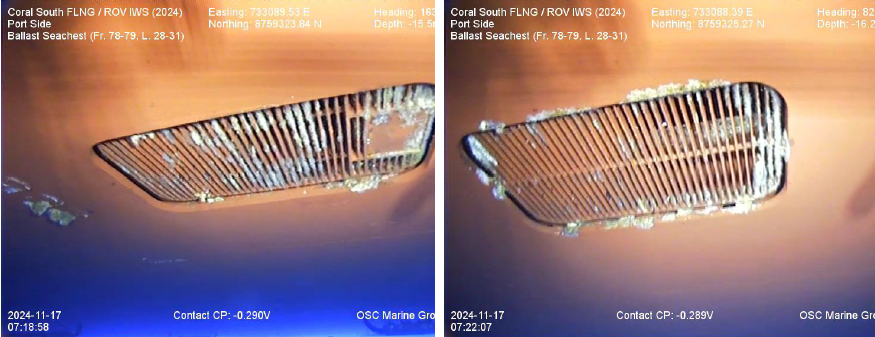
- Close visual inspection of sea chests following cleaning
- Positional fixes to confirm asset catenaries
- Cathodic protection potential measurements
- Photogrammetry of selected structures and components
Hull and Sea Chest Inspection
The general visual inspection of the hull covered:
- Side and bottom hull structures
- Bow and stern areas
- Sea chests
- Vessel anodes and attachment points
- Anode depletion levels
- Weld seams
- Bilge keel
- Thrusters and their vessel attachment points
- Marine growth across all inspected areas
Close visual inspections were completed along three bands extending from the starboard side, across the flat bottom, and towards the port-side shell. These were located:
- Beneath the aft machinery spaces
- Beneath the forward machinery spaces
- At midship
Marine growth was identified on the sea chests during the general inspection. Following agreement with the client, the sea chests were cleaned to expose the underlying structures and allow close visual inspection.

External and Internal Turret Inspections
The external turret inspection included:
- General condition of structural plates and welds
- Marine fouling and paint condition
- Identification of visible damage
- Condition of the four access holes
- Riser connections
- Acoustic monitoring receivers beneath the chain table
- Anodes, attachment points, and depletion levels
- Declination angles across the Chain Support Assemblies
- Radial spacing between the Chain Support Assemblies
- Condition of the lower bearing
A general visual inspection was also completed in each quadrant of the internal turret, covering:
- Upper sections of the 20 mooring chains
- Internal vertical sides
- Top of the chain table
- Accessible bearing inspection openings
- Anode depletion
Mooring System Inspection
The ROV survey of the mooring system covered:
- Chain Support Assemblies
- As-found condition and position of chain retainers
- Chain links above the final load-bearing links
- Condition and attachment of lifting tag lines
- Guide keys used during Chain Support Assembly deployment
- Top chain and lower connectors
- Spacer chains
- Accessible sections of polyester rope
- Anodes, attachment points, and depletion levels
The survey also confirmed whether relevant chain links were slightly slack and were not bunched above the chain retainers.
Risers, Umbilicals and Pipework
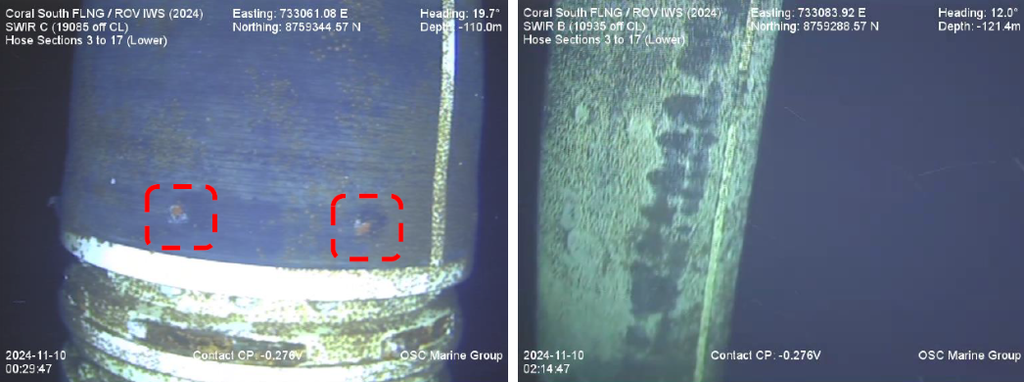
The complete lengths of the seawater intake risers were inspected, including:
- Flexible hoses
- Rigid connectors
- Anodes
- Strainers
- Anode attachment points and depletion
- Excessive movement at various water depths
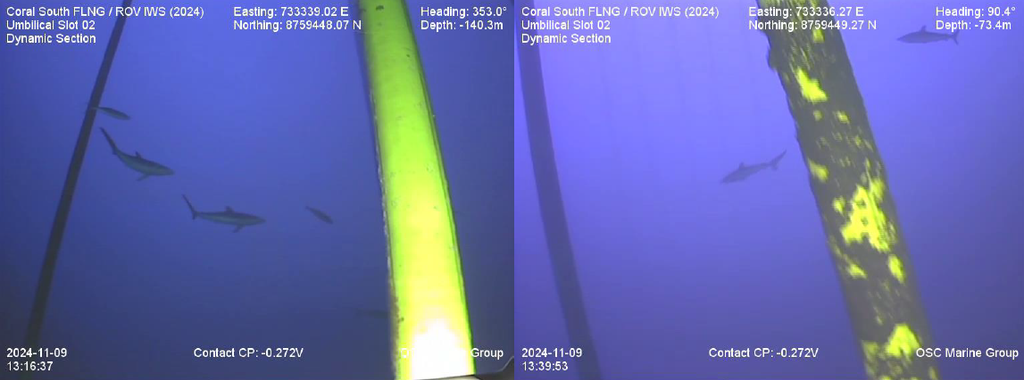
General visual inspections were conducted on all nine umbilicals and risers, covering:
- Interfaces with the FLNG
- Buoyant or bend stiffener connector connections
- Flexible sections extending to 250 metres water depth
The produced treated water extension line inspection included:
- General condition of the pipework
- Flanged connections
- Support bracing
- Stabilising rigging assemblies
- Interfaces between the rigging assemblies and the vessel
Positional Surveys
Positional fixes were recorded to confirm the catenaries and configurations of critical subsea assets. These included:
- Umbilicals and risers at approximate water-depth intervals of 10 to 20 metres
- Mooring chains at approximate water-depth intervals of 10 metres
- Joining H-links on all mooring chains
- Thimble H-links on all mooring chains
Cathodic Protection Measurements
Cathodic protection potential measurements were captured at specified locations accessible to the ROV.
These measurements supported the assessment of the condition and performance of the FLNG’s cathodic protection system at the inspected locations.
Photogrammetry
Photogrammetry was conducted on each of the four DACSA clusters to:
- Assess interfaces with the turret structure
- Identify possible distortion, abnormalities, or buckling
- Capture the angle of each DACSA relative to a fixed point
- Support comparison with historical values supplied by the client
Photogrammetry was also used to capture specified dimensions of selected chain links in accordance with the relevant SOFEC documentation.
The required level of chain-link cleaning could not be achieved during the campaign. The dimensional measurements will therefore need to be repeated during a future inspection.
Project Outcome
The campaign delivered:
- Detailed visual inspection records
- Close visual inspection footage
- Asset positional data
- Cathodic protection readings
- Photogrammetric records
- Survey information for class and client review
By combining several inspection and measurement techniques in one coordinated campaign, OSC Marine provided the client and attending Lloyd’s Register surveyor with structured information covering key areas of the FLNG and its associated subsea infrastructure.
Conclusion
The FLNG Coral South project demonstrated OSC Marine’s ability to execute extensive ROV inspection campaigns on complex floating production assets.
Through detailed survey planning and specialist ROV operations, OSC Marine successfully documented the condition and positioning of critical hull, turret, mooring, riser, umbilical, and subsea components offshore Mozambique.